
I recently found an advert that proudly announced:
“Native English Teacher… If you don’t use it, you’ll loose it!”
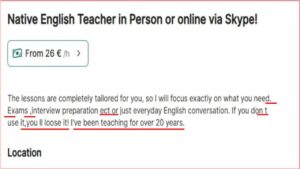
Nothing says “trust me with your language development” quite like immediately proving you can’t spell lose.
But let’s dig in, because this is one of my favourite myths:
If you’re a native speaker, you can teach English.
By that logic:
- I’ve been watching football for 20 years, so I’m ready to coach Real Madrid.
- I’ve eaten thousands of meals, so please welcome me as head chef at a Michelin-star restaurant.
- I’ve used WhatsApp daily, so clearly I can now work at Meta Platforms.
It’s a beautiful system. Zero training required. Just vibes.
The advert also proudly states:
“Lessons tailored exactly for you… exams, interviews, ect…”
“Ect.” is doing a lot of work here. Mostly replacing the word etc. and any sense of credibility.
And then there’s the classic:
“I’ve been teaching for over 20 years.”
Which raises an important question:
Teaching what, exactly? English… or creative spelling?
Look, being a native speaker means you’re fluent. That’s great.
But it doesn’t mean you understand the language.
Ask a random native speaker:
- Why do we say “I’ve just eaten” but not “I’ve just ate”?
- What’s the difference between “for” and “since”?
- Why is English like this?
You’ll usually get one of three answers:
- “It just sounds right.”
- “I dunno.”
- A long pause followed by existential confusion.
Meanwhile, a trained teacher is out here explaining:
- verb tenses
- pronunciation
- common learner errors
- why English has 47 exceptions to every rule
And doing it without emotionally collapsing halfway through.
Also, can we talk about “conversation classes”?
Some of these “teachers” are basically:
- Sitting there
- Asking “So… what did you do today?”
- Nodding a lot
- Occasionally saying “Very good!”
Congratulations. That’s not a lesson. That’s a coffee with a stranger you’re paying.
Let’s be honest: if being a native speaker was enough, every single person in the UK would be a grammar expert.
Have you heard some of us?
We’ve got:
- “I ain’t done nothing.”
- “Should of gone.”
- “There going to there house.”
If this is the gold standard, we’re all in trouble.
And before anyone says, “But natives help with pronunciation!”
Yes. So does shouting at your TV while watching Premier League. Doesn’t mean it’s structured learning.
A good teacher, native or not, English or Spanish, actually knows:
- how to explain grammar
- how to build lessons
- how to correct mistakes (without destroying your soul)
- how to adapt to different learners
And – this is controversial – they can usually spell basic words.
So by all means, learn from native speakers. Some are fantastic teachers.
But don’t choose someone just because they were born into the language.
Because if you don’t use your brain when choosing a teacher…
You might loose your money.
And honestly, that mistake never gets old.
Absolutely love this!